AlgoTrendTraders Weekly Report - Will AI Cause the Next Bear Market?
Disciplined, Rules-Based Trading

Thomas Meyer, Editor | February 23, 2026
Email: algotrendtraders@gmail.com | X: @AlgoTrendTrade1
Welcome to this week’s AlgoTrendTraders report. We hope you’re enjoying and learning something that helps you in these newsletters. We want you to understand how you can control your risk more effectively.
The data and charts shown in this report are not meant to be recommendations and no buy/sell information is inferred. Please read the disclaimer underneath the charts.
Tom’s Musings
There’s a new bullish trade this week in SPY. However, SPY closed the week barely above the yellow channel Transition Zone (TZ). The top of the TZ is $688.58. As of Sunday night, the futures are down almost 1%. If SPY opens on Monday at or below $688.58, the bullish trade is cancelled, and we’ll wait to see what happens this week.
Note: SPY opened below the top of the TZ and there is no bullish trade this week.
The other trades have been updated in the table and charts below.
I’ve been learning a lot about AI lately. I wrote about it a couple of months ago. Here are some more quick thoughts, feel free to agree or disagree.
HITL is critical! That means “humans in the loop”. The amount of errors and misinformation using AI is frustrating and probably to be expected.
I’ve been working intensely for about 6 months to update and test the trend-following program. The system was introduced more than 75 years ago. The program I had been using had a few bugs and wasn’t 100% accurate. It used to take an hour to adjust the output for the correct numbers. Now, I can get the same thing done in about 20 seconds.
All that is great and I’m proud of what’s been put together. But the process has been painstakingly slow. Every adjustment to the program has taken hours to examine and correct. There have been so many mistakes made by the AI program. Fortunately, the overall progress has been mostly positive.
AI will not stop a bear market from happening!
AI is truly amazing and powerful. But it might not be different than the output that doomed Long Term Capital Management almost 30 years ago. If you’re unfamiliar with the story, look it up. Basically, Nobel prize winning economists developed a model that couldn’t lose. Their plan was to invest in currencies, leverage it to maximum levels, and make a ton of money. After all, these were the smartest guys in the world, and their models told them they couldn’t lose money.
Of course, we all know what happened and how they got crushed. The smartest people. The best algorithms. All of their planning, and algorithms, and testing were perfect in their ivory tower offices. When their models encountered conditions that “couldn’t occur”, they broke down and lost billions of dollars.
I believe we’ll see something similar occur with the current AI models. So many people are using them, developing great new programs, backtesting, refining, and more backtesting. It sounds great. The investment models are “perfect” for any market condition.
Except something will happen that will break these models. There’s no way it can’t happen. The AI programs are learning from themselves. It’s possible that this becomes a self-fulfilling loop. And when the break occurs, we’ll have a bear market! That’s why you should consider using a trend-following model for at least some of your investments.
The trend-following model is still a simple model. If the trend is moving higher, go long. If the trend is moving lower, go short. And if the trend is moving sideways, stay in cash.
Of course, it’s not that simple. Markets don’t move in a straight line higher or a straight line lower. Whipsaws are the Achilles heel of trend investing. They’re going to happen and you’ll have losing trades, lots of them. But when the trends stay in place for a long time, the potential to have profitable trades is high.
There’s a lot more we can discuss, but these are the points I want you to think about. Feel free to email me and let me know what you’re thinking.
Focusing on the current trades:
The long QQQ trade is still in place, but it is still down a few percentage points. I would not enter into a new long position if you’re not already into this trade.
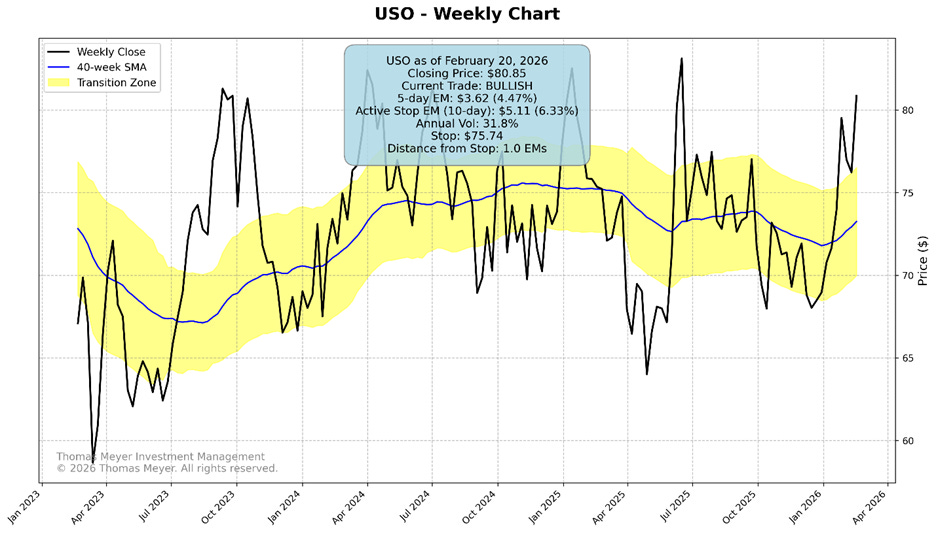
The long USO trade was entered last week. It’s now nicely profitable, but the stop hasn’t caught up yet to the cost basis. As we mentioned before, the 3-year chart on USO isn’t very optimistic for trend traders in either direction, but we’re nearing the 3-year highs for oil so this could push higher.
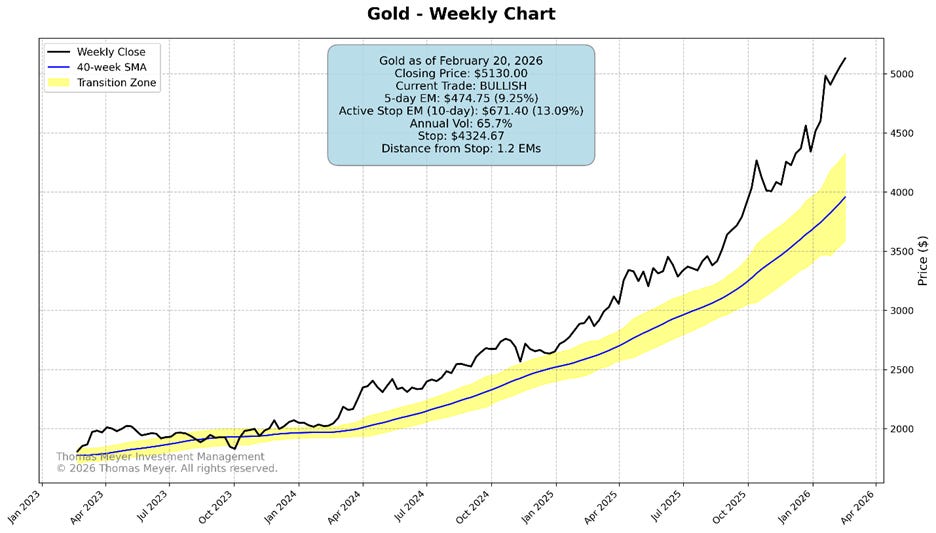
The long Gold trade has now been in place more than 13 months. The first long trade in gold was triggered more than 2 years ago when gold was barely over $2000. It hit its stop in December 2024 and 2 weeks later triggered a new long trade. That’s more than 2 years in a long trade with just a short break. The week-ending charts we use don’t show the volatility of the daily chart, especially over the past couple of months. It looks like the price could be consolidating at this higher level.
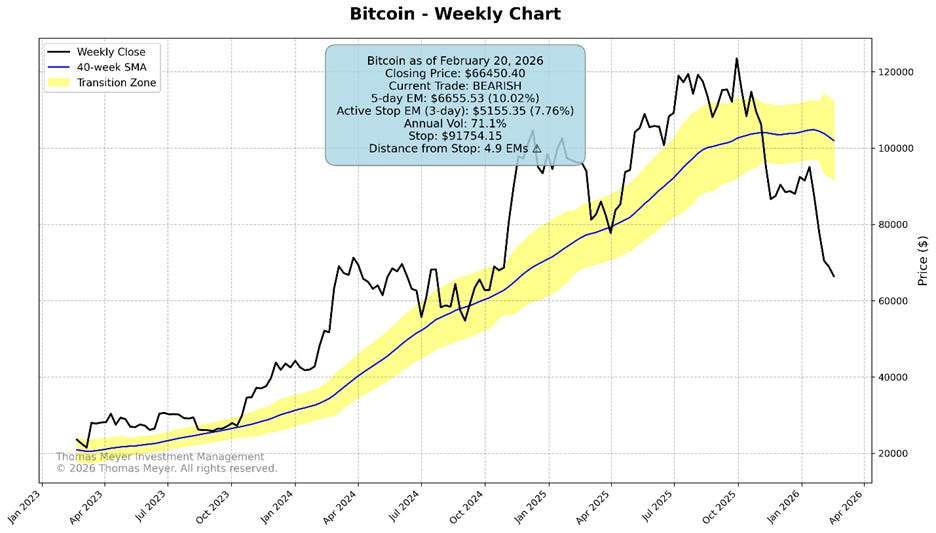
The short Bitcoin trade remains in place. Again, I know I sound like a broken record (and I’m showing my age by using that term), but please be sure you have an exit in place that locks in a profit. We could see Bitcoin move down to $50,000 or lower, and we could see it move higher in a short period of time. I don’t know what’s going to happen. I do know that there’s no reason to take a profitable trade and turn it into a losing trade.
Thomas Meyer Investment Management
If you’re not comfortable doing this on your own, and you’d like some help, there’s a simple solution. Let me do it for you! Anyone wanting to learn more about my investment management can check out the website for more information. Be sure to click on the “Let’s Connect” tab, fill it out, and we can discuss the next steps for me to manage a portion of your investable assets. By the way, I never actually hold your monies, they remain in your name, and the funds are custodied at Charles Schwab on the institutional side. Here’s my website: www.tminvestmentmanagement.com
Market Overview
Markets opened lower Monday, cancelling the new SPY bullish trade before it could even begin. SPY now sits in neutral territory as it works through this correction.
QQQ is hanging on at 0.8 Expected Moves from the exit, still down from the February entry. If you’re in this trade, don’t add to it—let it prove itself first.
USO is now profitable after last week’s entry, sitting exactly 1.0 Expected Move from the stop. Oil is approaching 3-year highs, which could fuel further gains if it breaks through.
Gold continues its relentless march higher, now past $5,130.00 and sitting comfortably 1.2 Expected Moves from the stop. That’s over 93% profit since January 2025—a textbook example of letting winners run for more than a year.
Bitcoin’s bearish trade keeps delivering. Now 4.9 Expected Moves from the stop with enormous profits locked in. Use a trailing stop to protect these gains—this level of profit won’t last forever without some volatility.
Historical Results For SPY, QQQ, Bitcoin
The trend-following approach I use has a decade-long track record across multiple newsletters in three countries. Here are the results for SPY, QQQ, and Bitcoin since I started publishing on Substack:
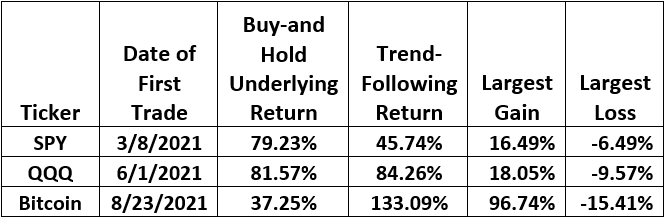
Always have your exit strategies prepared before you enter into any trade.
Current Conditions for February 23, 2026
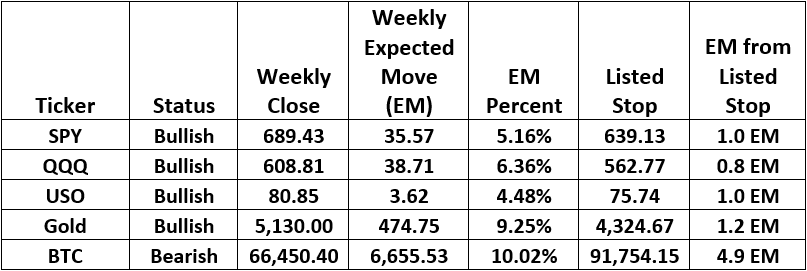
Be Sure to Read the Disclaimer at the End of This Report
Here are the latest charts…
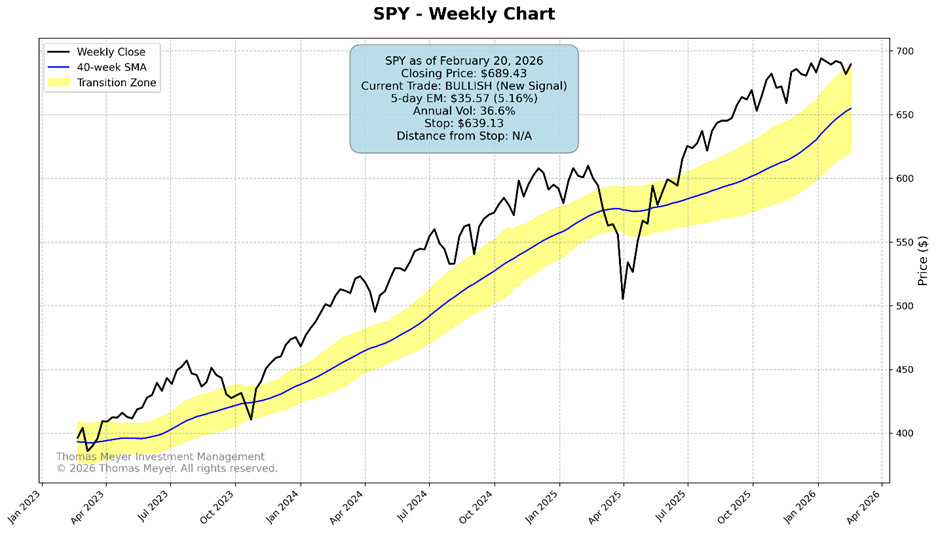
SPY (SPDR S&P 500 ETF)
Friday’s Closing Price: 689.43
Current Condition: Bullish
Weekly Expected Move: 35.57 (5.16%)
Stop: 639.13
Distance from Stop: 1.0 Expected Moves
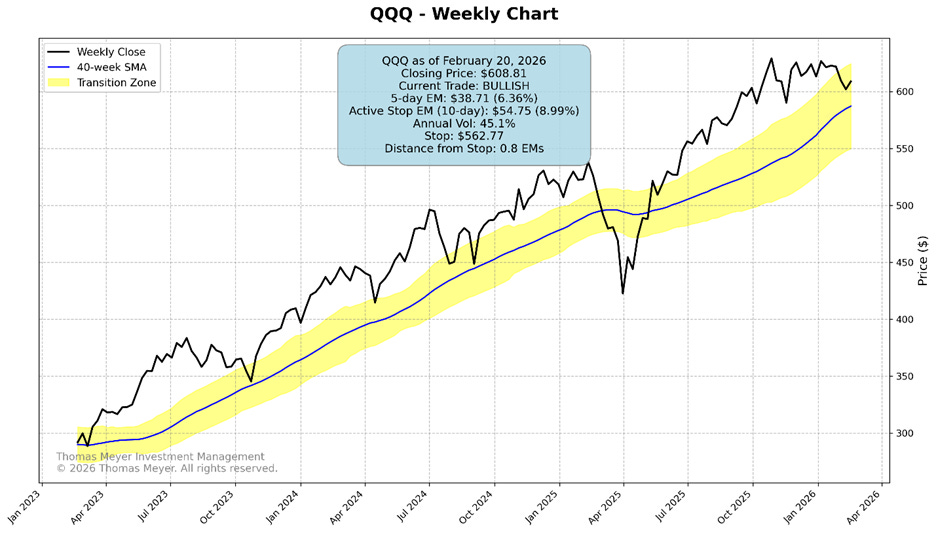
QQQ (Invesco NASDAQ 100 ETF)
Friday’s Closing Price: 608.81
Current Condition: Bullish
Weekly Expected Move: 38.71 (6.36%)
Stop: 562.77
Distance from Stop: 0.8 Expected Moves
Current Trade Entry Price: 618.70
Current Trade Entry Date: 02 February 2026
USO (USCF Crude Oil ETF)
Friday’s Closing Price: 80.85
Current Condition: Bullish
Weekly Expected Move: 3.62 (4.48%)
Stop: 75.74
Distance from Stop: 1.0 Expected Moves
Current Trade Entry Price: 76.83
Current Trade Entry Date: 09 February 2026
Gold (Current Futures Contract)
Friday’s Closing Price: 5,130.00
Current Condition: Bullish
Weekly Expected Move: 474.75 (9.25%)
Stop: 4,324.67
Distance from Stop: 1.2 Expected Moves
Current Trade Entry Price: 2,652.80
Current Trade Entry Date: 06 January 2025
BTC (Bitcoin)
Sunday’s Closing Price: 66,450.40
Current Condition: Bearish
Weekly Expected Move: 6,655.53 (10.02%)
Stop: 91,754.15
Distance from Stop: 4.9 Expected Moves
Current Trade Entry Price: 87,041.62
Current Trade Entry Date: 26 January 2026
Understanding Trend-Following
For new readers: here’s what this system is and why it works.
Trend-following isn’t about getting rich quick. It’s about attempting to make money slowly—and keeping it. This system relies on a proven process: capture solid gains on winning trades while limiting losses on trades that don’t work out. We’re the tortoise, not the hare.
The Core Principle
We don’t try to predict the market’s next move. Instead, we measure what’s actually happening each week and follow the evidence. Our algorithms determine the current trend and calculate exit strategies based on each security’s normal volatility.
Why Weekly Data Matters
By using weekly closes, we ignore the day-to-day noise that causes most investors to make emotional decisions. This gives us clearer signals and better long-term results.
How Risk Management Works
When a trade moves against us, we exit with a small, controlled loss. But when a trade trends for months—like our current Gold position, up 93% over 13 months—we let it run as long as the trend remains intact. This asymmetry is how trend-following generates wealth over time.
Entry Timing
The best time to enter is when a fresh signal triggers—you’re getting in at the start of a potential long trend. Entering mid-trend is possible but riskier. If you’re chasing a trade that’s already well-established, consider using half or one-third of your normal position size.
A Word on Leverage
Experienced investors sometimes use options or leverage with trend-following signals. This amplifies both gains and losses. Never risk more than you can afford to lose—no matter how confident you feel about a trade.
The Bottom Line
Trend-following requires patience and discipline. But for investors who want to participate in market gains while protecting against catastrophic losses, it’s one of the most reliable strategies ever developed.
Disclaimer
The information published in this newsletter should not be used to make personal investment decisions. We do not know your personal financial situation. Investments should be made only after consulting with your professional investment advisor and only after reviewing the prospectuses or financial statements of the companies in which you’re considering investing.