AlgoTrendTraders Weekly Report - Does the War Really Matter to the Markets?
Disciplined, Rules-Based Trading

Thomas Meyer, Editor | March 16, 2026
Email: algotrendtraders@gmail.com | X: @AlgoTrendTrade1
Welcome to this week’s AlgoTrendTraders report. We hope you’re enjoying and learning something that helps you in these newsletters. We want you to understand how you can control your risk more effectively.
The data and charts shown in this report are not meant to be recommendations and no buy/sell information is inferred. Please read the disclaimer underneath the charts.
Tom’s Musings
Good morning everyone, there continues to be a lot happening in the markets as the morning futures are solidly higher.
In my webinar last week, I discussed the 2 potential outcomes of the war with Iran. The first, and most likely outcome in my opinion, is that the war is short in length and it ends with true regime change. This would be a very bullish outcome.
The second outcome would be a war that lasts a long time which would be bearish for the markets as oil prices could remain extended for a long time.
Either way, the results will be reflected in the prices of tickers we all follow. For this week, there were no changes in the conditions of any of the tickers.
Allow me a little personal reflection…
When you think about it, the Iran conflict hasn’t changed anything about the long-term prospects of the stock market. For most of us, we’re in our homes, living our daily lives, reading the headlines—and we’re mostly unaffected.
We’re fortunate not to be in the middle of it. We’re not being shot at. We’re not running to bunkers every few hours. What a blessing.
But millions of people have lived under this regime for nearly 50 years. If regime change happens, it could free almost 100 million people to participate in the global economy. Imagine a stock exchange in Tehran. Iranian ETFs we can invest in. An entire nation of entrepreneurs and builders entering the world market.
The potential is incredible. It would be similar to what we saw 40 years ago with the fall of the Iron Curtain and the reunification of Germany—the rise of Eastern European economies and markets that didn’t exist before.
Hopefully it comes soon, and we get to witness the sheer brilliance of humanity building bold new economies and lives.
A Note on the Future of This Newsletter
After five years of weekly publishing, I’ll be retiring AlgoTrendTraders after the March 30th edition. I’m redirecting my weekends to what I do best: managing client portfolios using these exact systematic strategies.
The final newsletter will include Substack-era results and details on how to work with me directly if you want this disciplined approach applied to your investments.
Thomas Meyer Investment Management
If you’re not comfortable doing this on your own, and you’d like some help, there’s a simple solution. Let me do it for you! Anyone wanting to learn more about my investment management can check out the website for more information. Be sure to click on the “Let’s Connect” tab, fill it out, and we can discuss the next steps for me to manage a portion of your investable assets. By the way, I never actually hold your monies, they remain in your name, and the funds are custodied at Charles Schwab on the institutional side. Here’s my website: tminvestmentmanagement.com
Market Overview
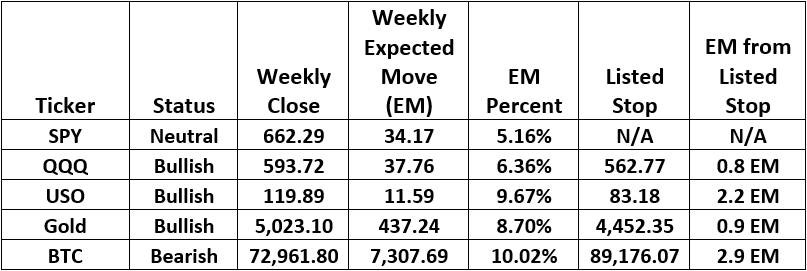
Futures opened solidly higher Monday morning as markets digest the Iran conflict. No changes in ticker conditions this week, but the underlying numbers tell an important story.
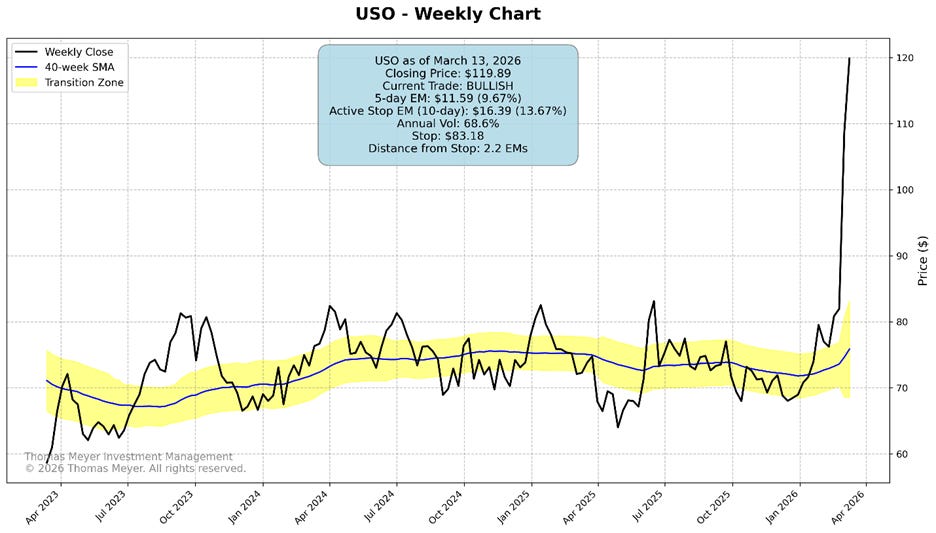
USO continues its remarkable run, now at $119.89—that’s 56% profit in just over a month since our February 9 entry. Volatility remains elevated at 9.67%, and the position is 2.2 Expected Moves from the stop. If you’re holding this trade, keep that trailing stop in place as discussed last week.
SPY remains neutral, continuing to consolidate. QQQ is still technically bullish but hanging on at 0.8 Expected Moves from the exit, down from the February entry. This position needs to prove itself before adding to it.
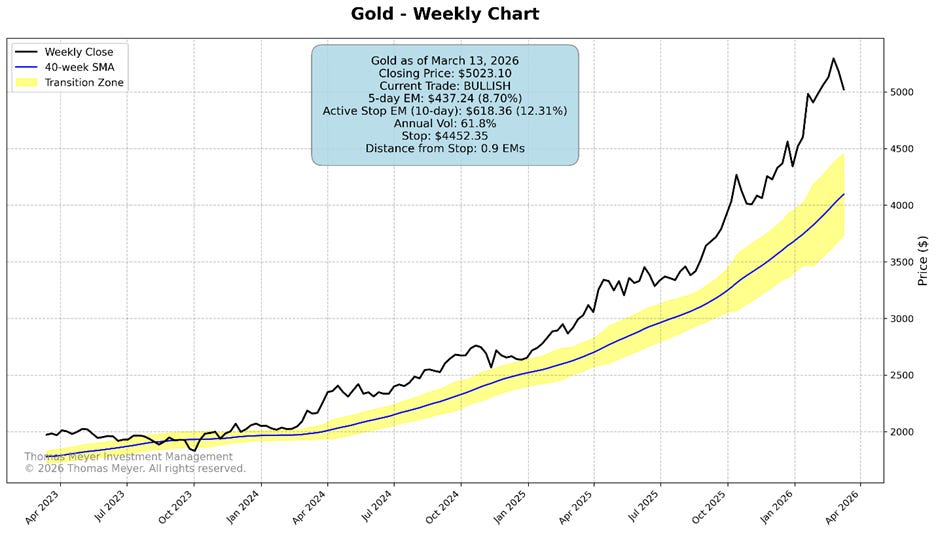
Gold pulled back to $5,023 but remains strongly bullish with 89% profit since January 2025. The stop has tightened to just 0.9 Expected Moves away—closer than it’s been in months. The trend remains intact but is getting tested.
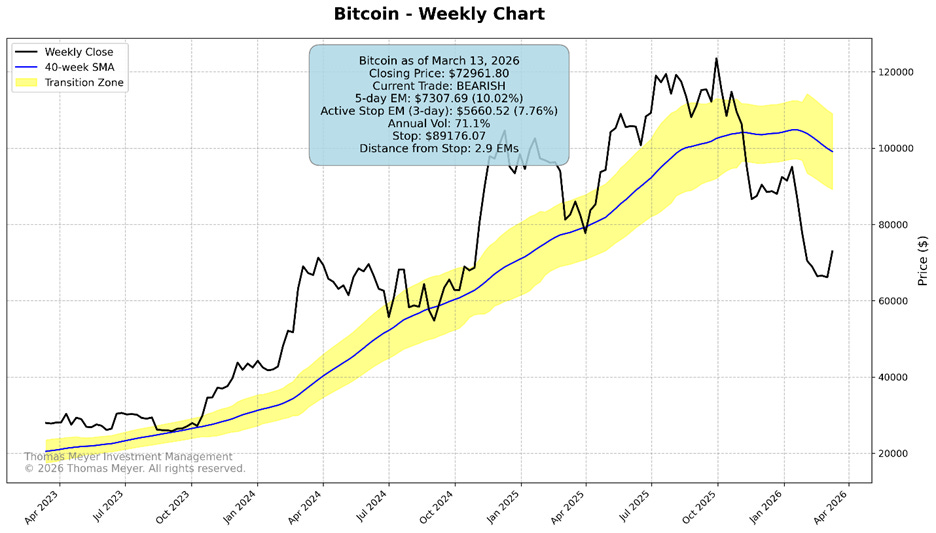
Bitcoin bounced higher to $72,961, reducing our short position profits. Now 2.9 Expected Moves from the stop (down from 4.6 last week). If you’re still in this bearish trade, consider tightening your trailing stop as the cushion is shrinking.
Markets are trading on headlines this week. Your systematic exits are your protection against emotion-driven volatility.
Historical Results For SPY, QQQ, Bitcoin
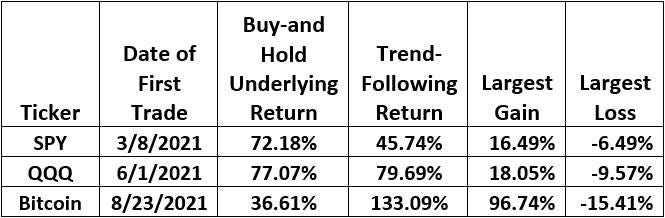
The trend-following approach I use has a decade-long track record across multiple newsletters in three countries. Here are the results for SPY, QQQ, and Bitcoin since I started publishing on Substack:
Always have your exit strategies prepared before you enter into any trade.
Current Conditions for March 16, 2026
Be Sure to Read the Disclaimer at the End of This Report
Here are the latest charts…
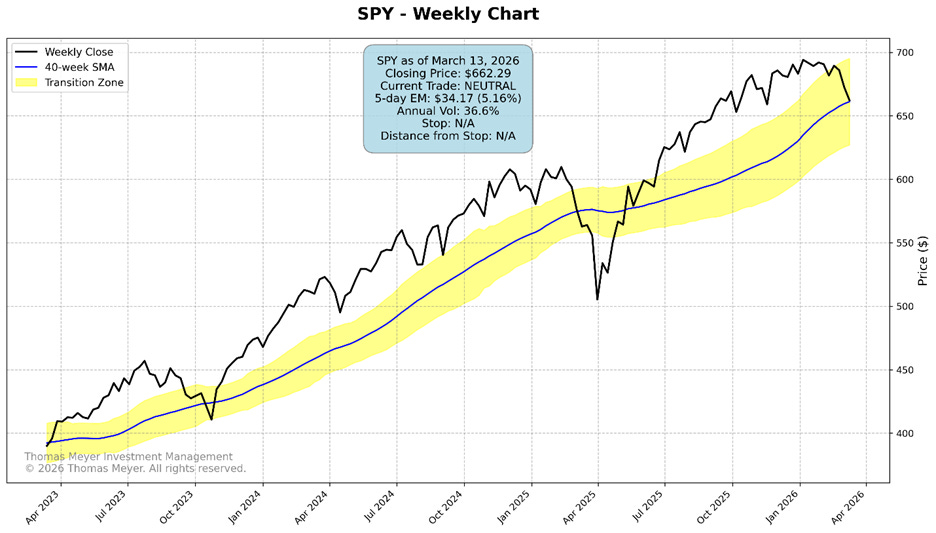
SPY (SPDR S&P 500 ETF)
Friday’s Closing Price: 662.29
Current Condition: Neutral
Weekly Expected Move: 34.17 (5.16%)
Stop: N/A
Distance from Stop: N/A
QQQ (Invesco NASDAQ 100 ETF)
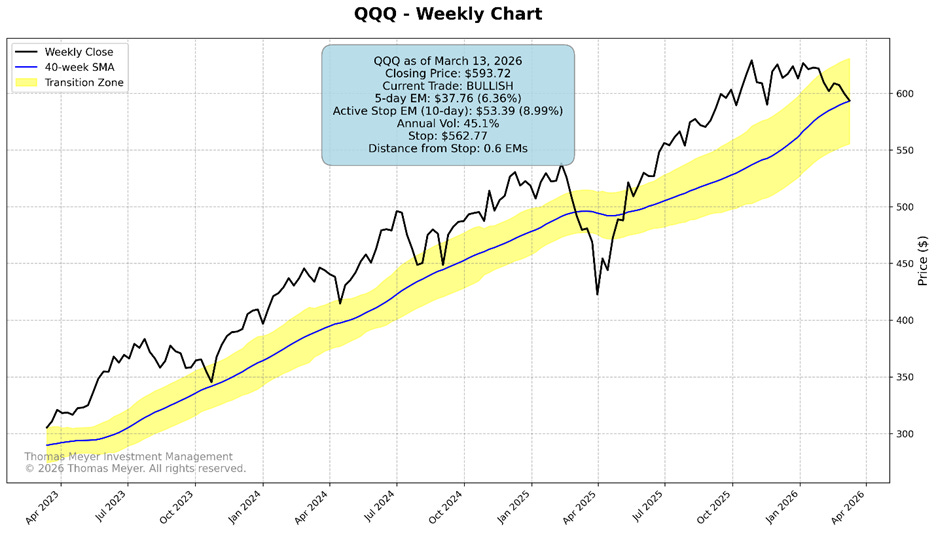
Friday’s Closing Price: 593.72
Current Condition: Bullish
Weekly Expected Move: 37.76 (6.36%)
Stop: 562.77
Distance from Stop: 0.8 Expected Moves
Current Trade Entry Price: 618.70
Current Trade Entry Date: 02 February 2026
USO (USCF Crude Oil ETF)
Friday’s Closing Price: 119.89
Current Condition: Bullish
Weekly Expected Move: 11.59 (9.67%)
Stop: 83.18
Distance from Stop: 2.2 Expected Moves
Current Trade Entry Price: 76.83
Current Trade Entry Date: 09 February 2026
Gold (Current Futures Contract)
Friday’s Closing Price: 5,023.10
Current Condition: Bullish
Weekly Expected Move: 437.24 (8.70%)
Stop: 4,452.35
Distance from Stop: 0.9 Expected Moves
Current Trade Entry Price: 2,652.80
Current Trade Entry Date: 06 January 2025
BTC (Bitcoin)
Sunday’s Closing Price: 72,961.80
Current Condition: Bearish
Weekly Expected Move: 7,307.69 (10.02%)
Stop: 89,176.07
Distance from Stop: 2.9 Expected Moves
Current Trade Entry Price: 87,041.62
Current Trade Entry Date: 26 January 2026
Understanding Trend-Following
For new readers: here’s what this system is and why it works.
Trend-following isn’t about getting rich quick. It’s about attempting to make money slowly—and keeping it. This system relies on a proven process: capture solid gains on winning trades while limiting losses on trades that don’t work out. We’re the tortoise, not the hare.
The Core Principle
We don’t try to predict the market’s next move. Instead, we measure what’s actually happening each week and follow the evidence. Our algorithms determine the current trend and calculate exit strategies based on each security’s normal volatility.
Why Weekly Data Matters
By using weekly closes, we ignore the day-to-day noise that causes most investors to make emotional decisions. This gives us clearer signals and better long-term results.
How Risk Management Works
When a trade moves against us, we exit with a small, controlled loss. But when a trade trends for months—like our current Gold position, up 89% over 14 months—we let it run as long as the trend remains intact. This asymmetry is how trend-following generates wealth over time.
Entry Timing
The best time to enter is when a fresh signal triggers—you’re getting in at the start of a potential long trend. Entering mid-trend is possible but riskier. If you’re chasing a trade that’s already well-established, consider using half or one-third of your normal position size.
A Word on Leverage
Experienced investors sometimes use options or leverage with trend-following signals. This amplifies both gains and losses. Never risk more than you can afford to lose—no matter how confident you feel about a trade.
The Bottom Line
Trend-following requires patience and discipline. But for investors who want to participate in market gains while protecting against catastrophic losses, it’s one of the most reliable strategies ever developed.
Disclaimer
The information published in this newsletter should not be used to make personal investment decisions. We do not know your personal financial situation. Investments should be made only after consulting with your professional investment advisor and only after reviewing the prospectuses or financial statements of the companies in which you’re considering investing.