AlgoTrendTraders Weekly Report - Advice from 1880: Why the Rules Never Change
Disciplined, Rules-Based Trading

Thomas Meyer, Editor | March 30, 2026
Email: algotrendtraders@gmail.com | X: @AlgoTrendTrade1
Welcome to the last week of my publishing the AlgoTrendTraders report. We hope you have enjoyed and learned lessons that have helped you in these newsletters. Publishing for 5+ years has been rewarding, now it’s time for me to focus 100% on my Registered Investment Advisory.
The data and charts shown in this report are not meant to be recommendations and no buy/sell information is inferred. Please read the disclaimer underneath the charts.
Tom’s Musings (Advice from 1880)
Try to take yourself back over 145 years. No cars, no electric lights, no internet. The biggest technologies of the time were trains and telegraphs. That’s the year my great grandmother was born in Fort Scott, Kansas.
So what does the year 1880 have to do with the stock market? Everything!
In 1880, a book came out titled “Speculation as a Fine Art” by Dickson Watts. Watts was president of the New York Cotton Exchange. He was no stranger to trading.
Even though there was no electricity, telegraph wires disseminated prices throughout New York and the rest of the country. That was the internet of its time! By the way, a young man named Thomas Edison had invented the Universal Stock Ticker in 1871.
Traders were fearful of the ticker tape and everyone having access to pricing information at the same time. Everything was moving so quickly!
Watts laid out his trading principles that are as true today as they were in 1880. He called them “Laws Absolute”:
“Cut losses short; let profits run”: This is perhaps his most famous contribution. He viewed the inability to admit being wrong as the greatest risk to a speculator.
“Never overtrade”: Watts believed that taking positions too large for your capital led to emotional decision-making, which “clouded the judgment.”
“Act on instinct”: He didn’t mean “guessing,” but rather the refined intuition that comes from years of observing market behavior—what we might call “pattern recognition” today.
“Don’t hesitate”: Once a condition for entry or exit is met, the speculator must act without the “fatal delay” of second-guessing.
Isn’t it fascinating that the same rules apply today as they did 145 years ago? We’ve developed incredible technology, yet we’re wired the same as we always have been.
We develop plans and don’t stick to them. We override our intellect. We have to prove ourselves right—the biggest risk in 1880 and today.
Successful traders understand that we’ll never squeeze every bit of profit from every trade. As trend-followers, our goal is to capture a percentage of a trend’s move. 50% if we’re fortunate, 75% if we’re very fortunate.
But when a trade doesn’t work out, we force ourselves to exit when the stop is hit. No second-guessing. We don’t have to like it, but we do have to stick to our process.
There’s no “perfect” system. Markets are messy and every system generates losing trades. You have to understand and accept that to be successful.
Thank you for your support and sticking with me all these years. You have my email address—feel free to contact me if you have any questions.
Wishing you many years of trading success!
Note on Open Trades:
There are currently 2 open trades: the long trade in crude oil (USO) and the short trade in Bitcoin. In previous issues, I recommended using trailing stops equal to 2 Expected Moves. Both of these trades have stopped out according to that recommendation. If you’re still in the trades and haven’t stopped out, consider using a trailing stop to lock in the large profits the system has generated.
Thomas Meyer Investment Management
If you’re not comfortable doing this on your own, and you’d like some help, there’s a simple solution. Let me do it for you! Anyone wanting to learn more about my investment management can check out the website for more information. Be sure to click on the “Let’s Connect” tab, fill it out, and we can discuss the next steps for me to manage a portion of your investable assets. By the way, I never actually hold your monies, they remain in your name, and the funds are custodied at Charles Schwab on the institutional side. Here’s my website: www.tminvestmentmanagement.com
Market Overview
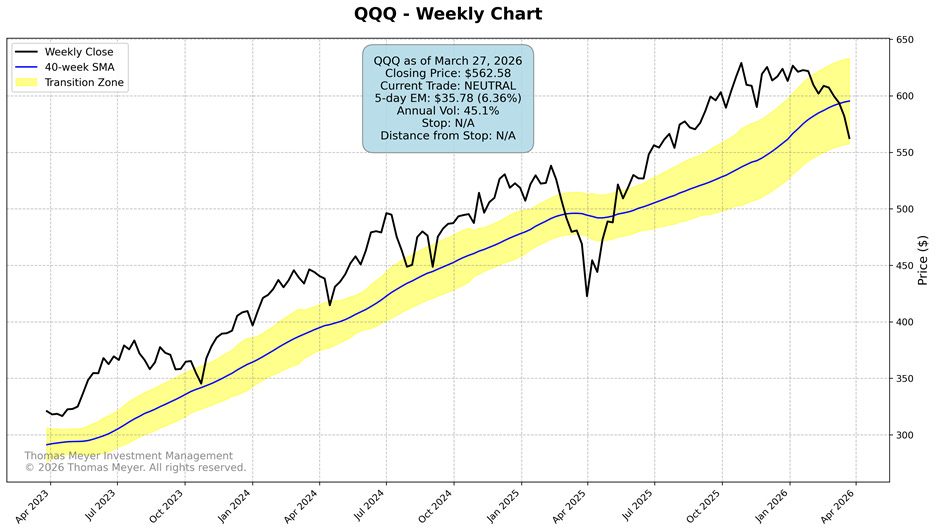
The final week brings significant changes. QQQ hit its stop, closing out a losing trade from the February 2 entry—down about 6% over 7 weeks. This is exactly what systematic exits are designed to do: limit losses when trends don’t materialize. QQQ is now Neutral.
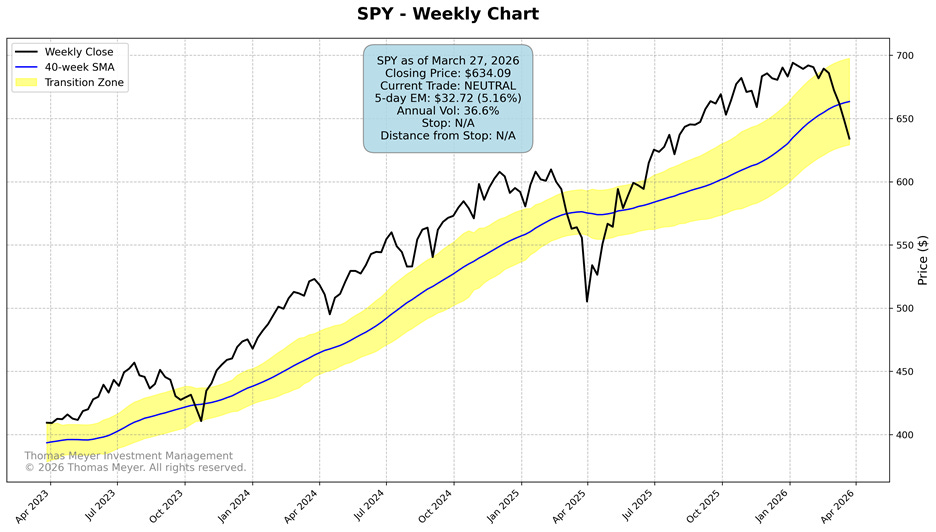
SPY remains Neutral, continuing to consolidate well below all-time highs as market uncertainty persists.
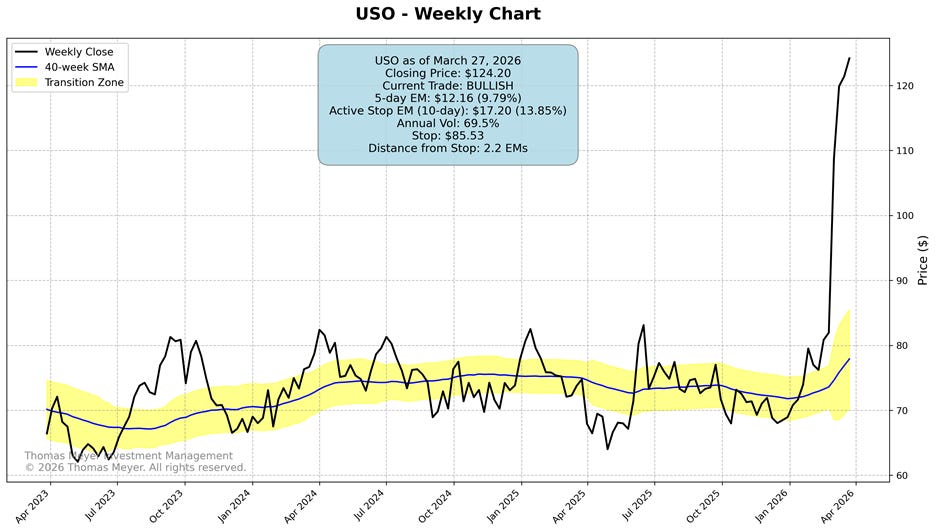
USO continues its extraordinary run at $124.20, now up 62% from the February 9 entry. This trade exemplifies what happens when geopolitical risk meets supply constraints—and why trailing stops matter when profits get this large. Still 2.2 Expected Moves from the stop with volatility near 10%.
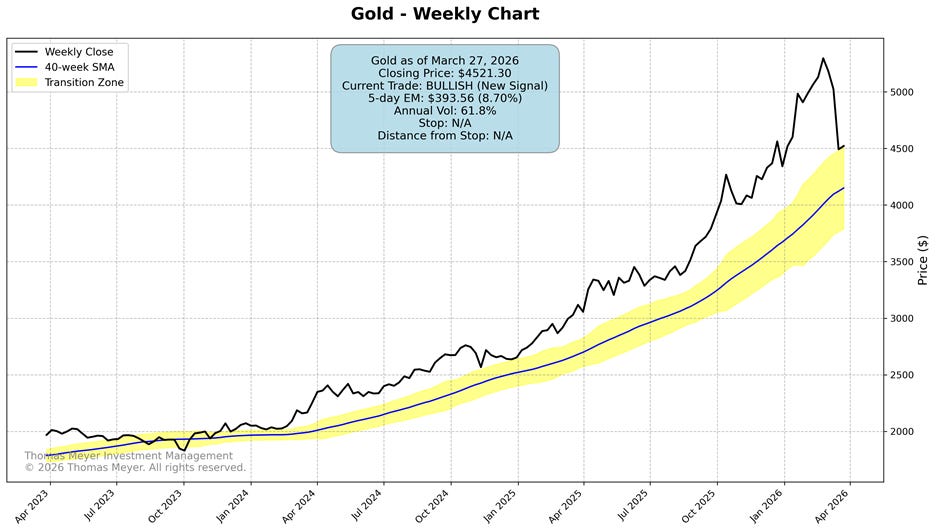
Gold sits in Neutral after last week’s 68% gain over 15 months was locked in. One of the best trades in the newsletter’s history.
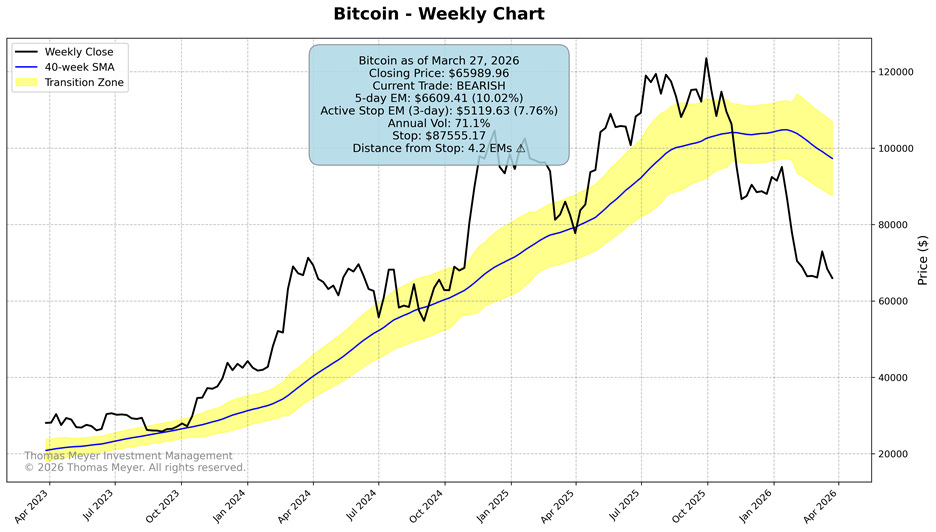
Bitcoin’s bearish trade is back to 4.2 Expected Moves from the stop as BTC continues lower. Another strong performer that demonstrates the value of shorting in bear markets.
After 5 years of publishing, the message remains the same: systematic entries, disciplined exits, and accepting that not every trade works. The principles from 1880 still apply in 2026.
Historical Results For SPY, QQQ, Bitcoin, Gold
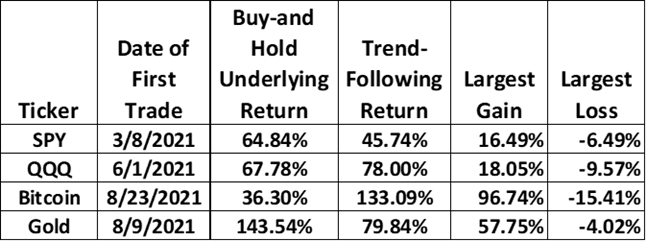
Here are the results for SPY, QQQ, Bitcoin, and Gold since I started publishing on Substack. The gold trades moved from GLD early on to futures prices the past two years. It really didn’t affect the outcome of the trades. Gold had strong whipsaws the first few years, but had a great couple of years as gold moved strongly higher.
Always have your exit strategies prepared before you enter into any trade.
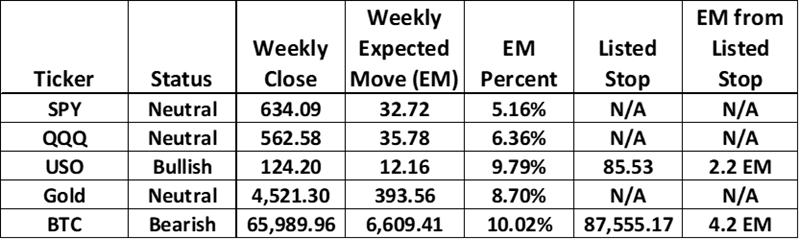
Current Conditions for March 30, 2026
Be Sure to Read the Disclaimer at the End of This Report
Here are the latest charts…
SPY (SPDR S&P 500 ETF)
Friday’s Closing Price: 634.09
Current Condition: Neutral
Weekly Expected Move: 32.72 (5.16%)
Stop: N/A
Distance from Stop: N/A
QQQ (Invesco NASDAQ 100 ETF)
Friday’s Closing Price: 562.58
Current Condition: Neutral (Trade stopped out this week)
Weekly Expected Move: 35.78 (6.36%)
Stop: N/A
Distance from Stop: N/A
USO (USCF Crude Oil ETF)
Friday’s Closing Price: 124.20
Current Condition: Bullish
Weekly Expected Move: 12.16 (9.79%)
Stop: 85.53
Distance from Stop: 2.2 Expected Moves
Current Trade Entry Price: 76.83
Current Trade Entry Date: 09 February 2026
Current Gain: +62%
Gold (Current Futures Contract)
Friday’s Closing Price: 4,521.30
Current Condition: Neutral
Weekly Expected Move: 393.56 (8.70%)
Stop: N/A
Distance from Stop: N/A
Most Recent Trade: +68% over 15 months (closed March 17)
BTC (Bitcoin)
Sunday’s Closing Price: 65,989.96
Current Condition: Bearish
Weekly Expected Move: 6,609.41 (10.02%)
Stop: 87,555.17
Distance from Stop: 4.2 Expected Moves
Current Trade Entry Price: 87,041.62
Current Trade Entry Date: 26 January 2026
Current Gain: +24%
Understanding Trend-Following
For new readers: here’s what this system is and why it works.
Trend-following isn’t about getting rich quick. It’s about attempting to make money slowly—and keeping it. This system relies on a proven process: capture solid gains on winning trades while limiting losses on trades that don’t work out. We’re the tortoise, not the hare.
The Core Principle
We don’t try to predict the market’s next move. Instead, we measure what’s actually happening each week and follow the evidence. Our algorithms determine the current trend and calculate exit strategies based on each security’s normal volatility.
Why Weekly Data Matters
By using weekly closes, we ignore the day-to-day noise that causes most investors to make emotional decisions. This gives us clearer signals and better long-term results.
How Risk Management Works
When a trade moves against us, we exit with a small, controlled loss. But when a trade trends for months—like our recent Gold trade that closed with 68% profit over 15 months—we let it run as long as the trend remains intact. This asymmetry is how trend-following generates wealth over time.
Entry Timing
The best time to enter is when a fresh signal triggers—you’re getting in at the start of a potential long trend. Entering mid-trend is possible but riskier. If you’re chasing a trade that’s already well-established, consider using half or one-third of your normal position size.
A Word on Leverage
Experienced investors sometimes use options or leverage with trend-following signals. This amplifies both gains and losses. Never risk more than you can afford to lose—no matter how confident you feel about a trade.
The Bottom Line
Trend-following requires patience and discipline. But for investors who want to participate in market gains while protecting against catastrophic losses, it’s one of the most reliable strategies ever developed.
The principles from 1880 still work in 2026. Cut losses short. Let profits run. Stick to your system.
Disclaimer
The information published in this newsletter should not be used to make personal investment decisions. We do not know your personal financial situation. Investments should be made only after consulting with your professional investment advisor and only after reviewing the prospectuses or financial statements of the companies in which you’re considering investing.